Battery system terminology:
A practical reference
The maritime battery industry uses a layered system architecture built on broadly shared conventions. Most suppliers follow the same fundamental hierarchy, from cell to complete battery system, though naming conventions and product-specific configurations vary. This glossary covers the core terms as they are used at Echandia. Most definitions align with general industry practice; where Echandia uses a specific term or structure, that is noted.
Cell | The smallest unit in a battery system. Echandia systems use LTO (lithium-titanate oxide) cells. | |
Cell group | A set of cells connected in parallel. Cell groups increase capacity while keeping voltage constant. | |
Module | A group of cell groups or cells connected in series, encapsulated together and monitored by the same CMU (Cell Monitoring Unit). The module is the primary building block for system configuration. | |
Module pack | A collection of modules encapsulated together with a pre-wired harness to a shared I/O interface. Module packs simplify integration at the shipyard by reducing on-site wiring. | |
String | Multiple modules connected, in series or parallel, to the same string controller. The string is the core operational unit of the battery system, monitored and controlled as a single entity. | |
Pack | A group of strings connected in parallel to the same DC bus. Pack configuration determines the total power and energy available to the vessel. | |
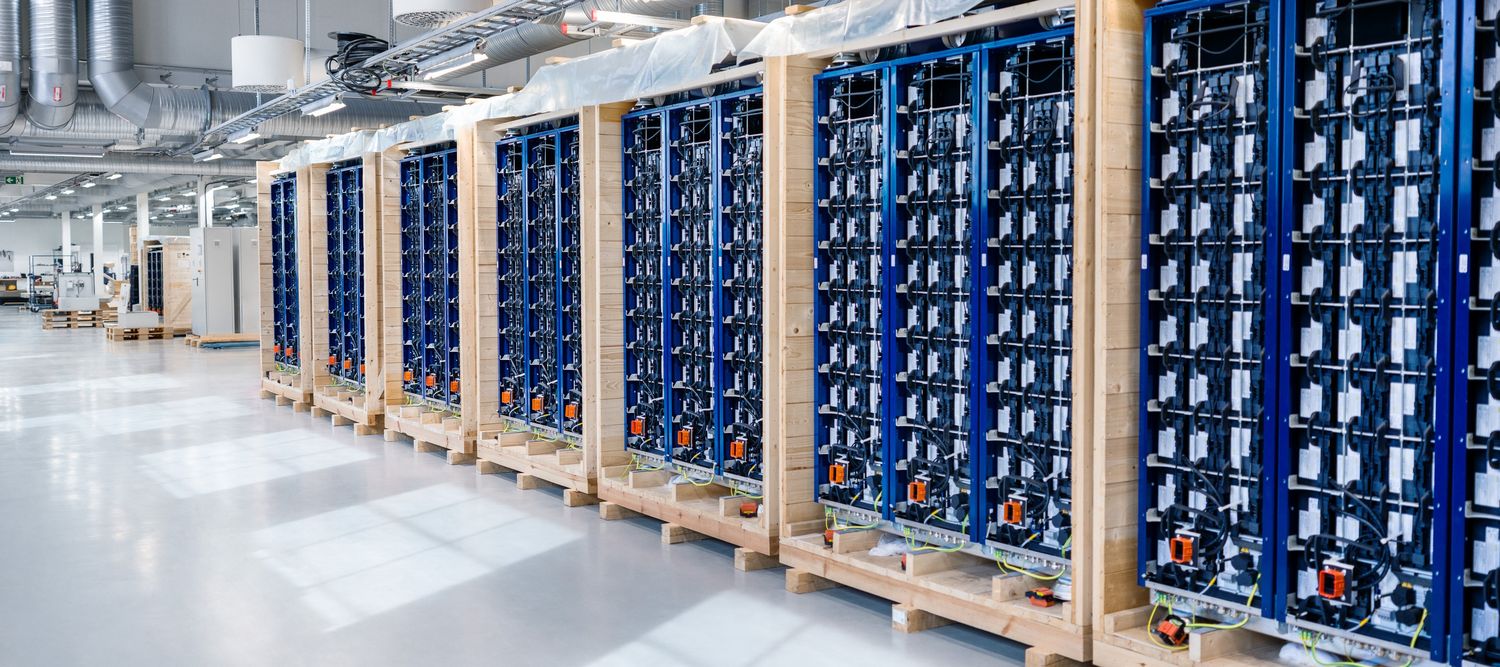
Rack | A metallic enclosure that houses modules. Racks provide physical protection and support the structural integration of modules within the vessel. | |
Rack group | Multiple racks mounted on the same mechanical frame. Rack groups are used where system size requires distributed physical placement. | |
Battery system | The complete installation: strings, string controllers, BMS, racks, and auxiliary equipment, all connected through the BMS. The battery system is what is specified, delivered, and commissioned as a unit. | |
BMS - Battery Management System | The main electrical cabinet and its internal components. The BMS is the top-level interface for the battery system, handling communication, protection, and system-level control. | |
CMU - Cell Monitoring Unit | A device that monitors cell voltage and temperature and controls cell balancing. Each CMU serves one module and provides the data that feeds into the string controller and BMS. | |
SCU - String Controller Unit | A controller that implements the control logic and interface functions for a single battery string. The SCU sits between the CMU level and the BCU. | |
SC - String Controller | An encapsulated unit containing the electronics required for monitoring, protection, and control of a single battery string. The SC houses the SCU along with associated protection hardware. | |
BCU — Battery Control Unit | The top-level controller for all string controllers in the battery system. The BCU coordinates system-wide operation and communicates with vessel systems via standard interfaces. | |
How to use this glossary
The hierarchy above reflects common practice across the marine battery industry, with some terms and boundaries that are specific to how Echandia structures and labels its systems. When working with Echandia documentation, datasheets, or project teams, these definitions apply. For terms not covered here, or where integration with other suppliers introduces different conventions, contact your Echandia project contact for clarification.
Want to know more?
Our team has worked with leading shipyards and system integrators, from ABB to Siemens, to electrify ferries, tugs, navy and transport vessels. We know what it takes to build a safe, durable system that performs every day.
